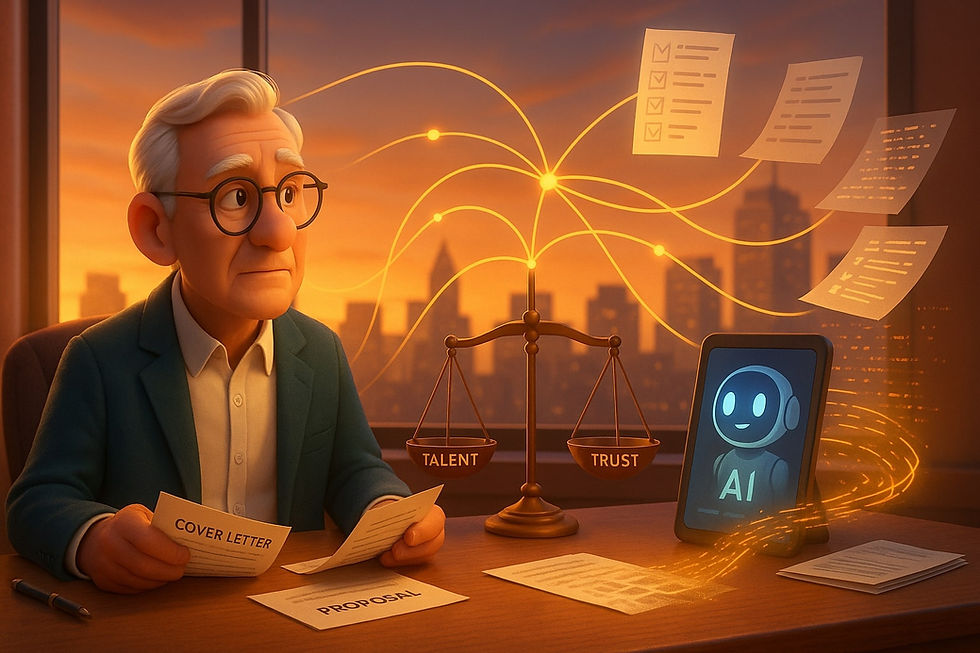
The Danish AI Disconnect: What 130 Companies Taught Me About Technology and Tillid
- Tom Hansen
- Oct 7, 2025
- 5 min read

Stillness in the AI Storm
In the global conversation about artificial intelligence, the dominant tone is one of relentless, accelerating change. Yet here in Copenhagen, in rooms filled with seasoned Danish leaders, I have observed something quite different.
Since June, I have facilitated six full day and five half day trainings on AI strategy for executives and senior managers from more than 130 different companies, representing everything from legacy industrial firms to agile tech startups. I came prepared to discuss roadmaps, governance models, and implementation tactics. Instead, I sometimes found a profound and unexpected stillness.
It was a hesitation rooted in a conflict that most global AI narratives completely overlook: the tension between the technological imperative for speed and the preservation of a deeply ingrained, human centric work culture. This is a space filled with unspoken questions about identity, community, and trust.
This article, therefore, is not a guide to AI adoption. It is a report from those rooms, an articulation of the crucial anxieties that are shaping the reality of AI’s reception in the Danish professional landscape, where progress is not measured by speed alone, but by its alignment with core human values.
Navigating the Noise of Progress
The initial challenge facing every leader I met is a paradox of credibility. They are caught in a crossfire of profoundly conflicting messages. One day, AI is presented as an existential threat to their business model, a force that will render them obsolete if they do not act immediately. The next, it is pitched as a magical solution, a turnkey technology capable of solving any operational challenge. This relentless noise from consultants, media, and technology vendors creates significant external pressure to demonstrate momentum.
The board asks for an AI strategy; competitors announce pilot projects. The expectation is to show "AI progress" on a quarterly report. Yet this pressure is met with a healthy and warranted skepticism. These leaders are wary of the hype, having seen previous technology waves come and go. They are far more concerned with the potential impact of untested tools on their firm’s carefully cultivated collaborative culture than they are with being the first to adopt a new platform. The result is a state of deliberate inaction, a thoughtful resistance to being rushed into decisions that feel disconnected from the tangible realities of their teams and the foundational values that define their organizations.
The Human Cost of Optimization
At the heart of this Danish disconnect is a fundamental concern that the global obsession with AI driven efficiency is a direct threat to fællesskab, the powerful sense of community that characterizes the nation’s workplaces. The fear, articulated in various ways, is that a campaign to optimize every workflow could systematically eliminate the very "inefficiencies" that build connection and psychological safety. These are the spontaneous conversations by the coffee machine that solve a problem that was blocking a project, the collaborative problem-solving sessions that take longer than a solo effort but result in a more robust outcome, the shared lunch breaks that build vital interpersonal relationships.
These interactions are the bedrock of tillid, the high level of trust that allows for autonomy and swift, decentralized decision making. The anxiety is therefore not merely about potential job losses; it is about losing the human fabric, the distinct collegiality, that makes a workplace feel like a community rather than just an economic entity. Leaders here understand that a company’s culture is not built on pure productivity metrics. It is forged in the small, unmeasured moments of human interaction that an algorithm would logically identify, and seek to eliminate, as unproductive slack.
Deep personal questions
Beyond the cultural anxieties lies a deeply personal and existential question about the future of expertise. Many professionals, particularly those in knowledge-based roles, harbor a profound fear that AI will commoditize their hard won skills. Their professional identity is built on years of experience, nuanced judgment, and the ability to engage in creative problem solving.
The perceived trajectory of generative AI tools, however, points toward a future where their role shifts from that of a creator or a critical thinker to a mere supervisor of automated outputs. They fear becoming validators of machine generated content rather than originators of valuable ideas.
This is not a simple fear of being replaced, which is an economic concern. It is an existential threat to their sense of purpose and mattering at work, a risk to their arbejdsglæde or work-joy. For leaders, this presents a critical challenge that transcends technology implementation. If the most skilled and experienced people in an organization see the future as one of diminished agency and intellectual outsourcing, their motivation will inevitably decline. The very innovation and quality that the company seeks to foster with AI will be fundamentally compromised from within.
An Affront to Tillid
The Danish leadership model is built on dialogue, distributed authority, and mutual trust. Sustainable change is achieved through collective agreement, not through executive fiat. This established cultural practice creates a direct collision with the typical top-down methods of technology deployment.
The introduction of powerful AI dashboards and analytics, for example, tempts a reversion to a style of micromanagement and employee surveillance that is culturally toxic in Denmark.
Similarly, an executive decision to issue a blanket ban on unapproved AI tools is almost universally interpreted as a fundamental lack of trust in employees’ judgment and professionalism.
Such a move not only stifles the organic, bottom-up innovation that leaders claim to want, it simply drives the behavior underground, making it invisible and impossible to manage or learn from.
Any attempt to impose a major technological shift without genuine, transparent consultation is viewed as a violation of this deep-seated social contract. It is almost certain to be met with a quiet but pervasive passive resistance that can undermine the entire initiative far more effectively than any vocal opposition.
A Map Hidden in the Shadows
A list of prescribed solutions cannot address anxieties that are fundamentally cultural and existential. However, within this complex landscape, a powerful starting point is the quiet, unsanctioned use of AI tools by employees. It’s often labeled "Shadow AI," and typically seen by IT departments as a compliance risk to be mitigated.
The findings from my sessions suggest a radically different perspective. This behavior is not defiance; it is a clear signal of unmet needs. Shadow AI reveals exactly where a team's greatest frictions, workflow bottlenecks, and highest levels of motivation lie. It provides a real time, user generated map of the precise points where people are actively seeking help to do their jobs better. Instead of imposing a technology from the top down, the most culturally astute and effective next step is to learn how to read this map. The path to a successful AI integration in Denmark begins not with a purchase order or a new policy, but with a simple, respectful question: what are our people already trying to solve ...? For an even more robust path forward, there is a deeper layer beneath the unmet needs that Shadow AI reveals: the team’s documented strengths. Beginning here is a strategic shortcut to momentum that aligns perfectly with a high-trust leadership model. By anchoring the initial initiatives in what the teams and organization already masters, a fundamental legitimacy is created, reducing the passive resistance that any significant change will otherwise trigger.
This also shifts the energy from uncertainty to agency, as employees see the technology as an augmentation of their existing professional competence, less as a threat to it. It honors the well-worn pathways of collaboration and the trust that already resides within them. Rather than first asking, “What are our pain points?”, this approach starts by asking, “What are our strongest capabilities?”. In a culture built on dialogue and distributed authority, this is the best starting point for succes.
Starting with strengths is also the first phase in the change mangement model I've developed for AI adoption.
The next two training session are October 21 and 29. Experienced users can jump directly to the second. You can read more about them here.